Strength Training for Rock Climbing
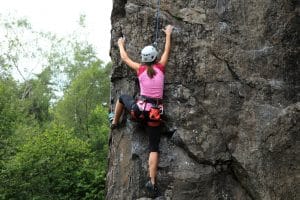
Rock climbing is a sport that requires strength, coordination, flexibility, endurance, and balance. It is an excellent cross training activity for many other sports such as basketball, racquet sports, and baseball which require strengthening the intrinsic muscles of the feet, lower legs, and hand grip. Psychological demands also come into play; such as puzzle solving skills, team building, and the ability to plan movements in advance. Climbing is a physically challenging, vertical chess match.
Common Muscle Imbalances
Although every individual is different, there are common muscle imbalances seen in regular rock climbers. Muscles that are commonly tight and need to be stretched include: latissimus dorsi, biceps, forearm and finger flexors. Muscles that are commonly weak and need to be strengthened include: wrist and finger extensors, anterior tibialis, pectorals and anterior shoulder girdle, triceps, rotator cuff and scapular stabilizers, mid and lower trapezius, trunk stabilizers such as spinal erectors and abdominals. Imbalances may need to be addressed not only to improve climbing performance, but to prevent injury.
Training Components
Components of a properly designed climbing program include flexibility, strength training, proprioception, balance and agility, plyometrics, aerobic and anaerobic cardiovascular fitness. Perhaps the most important aspect of training for climbing involves learning movement patterns that involve body positioning, weight transfer, and learning how to move efficiently. Lower body strength is often overlooked in climbing training programs, but is an important aspect of a well planned program. The exact parameters of a properly designed training program depend not only on the individual climber, but on what type of climbing is being targeted. It is recommended that participants take courses in skill development and safety in addition to physical training regimens.
Common Climbing Injuries
Some of the most common climbing injuries are a result of repetitive stress to muscles in the forearm and fingers that result in tendonitis of the fingers, wrist or elbow. Rotator cuff injuries are also common, usually as a result of muscle imbalances or weakness. Ankle sprains also occur, usually on descent hikes or bouldering falls. It is important that all climbing harnesses, helmets, ropes and equipment be properly maintained and checked regularly!
Training Program Options
Option 1.The most effective option is to work one on one with a professional Strength and Conditioning Coach to ensure that you are doing the most efficient exercises correctly. You will first have an assessment to determine your current cardiovascular fitness, flexibility, and muscle strengths and weaknesses prior to beginning a training program. We will then utilize that information to design a customized program that determines appropriate exercises and intensities so that you can maximize your climbing performance and minimize the chance for injury. Since there are no contracts, you can work with your trainer as often or as little as you please. Contact K’s Body Shop to schedule your appointment or get more information.
Option 2.If you have a group of climbers in the Twin Cities area who are interested in having a professional Strength and Conditioning Coach oversee your small group strength training workouts, contact K’s Body Shop. This is a great option for training partners to contain costs while still getting some professional instruction. Since each athlete is different, the workouts will not be completely customized, but you will have the opportunity to discuss appropriate exercise progressions based on your abilities. Prices vary depending on number of participants and location of sessions.
Option 3. If you are comfortable with technology and relatively healthy, Online Coaching can be a cost-effective alternative to face to face training. Check out our free trial to see how the software works!
Contact the Coach if you need help deciding which option is most appropriate for you.